Eva-Fiore Kovacovsky

Roger%20Fenton1860%20albumen.jpg

Perhaps it's the vestigial art historian in me, but I love still lives with fruit. I like them precisely because they are so mundane. Artists have been attempting them for something like 3000 years and so often they fail which is why a good one jumps off the wall.

'Portraits of fruit' as I refer to them were one of the first impulses of photographers. Daguerre himself took many. For the next hundred years most photographic still lives were primarily lush 'our bounty overfloweth' type images taken by painter/photographers like Roger Fenton (the image at the beginning of this post is one of his from 1860) or vanitas of decay (again usually taken by photographers schooled as painters).... After almost 100 years of this the surrealists finally punched life back into the form starting in the late 20's.
manrayuntitled1931.jpg
(In my fantasy art collection I would own this little Man Ray peach from 1931)
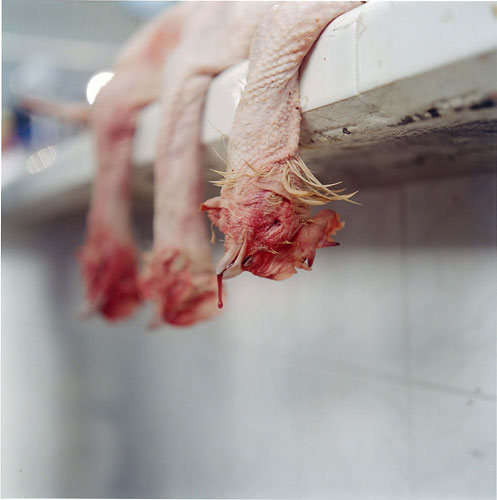
Anyway this is all a long winded way of saying making an interesting still life is a tough artistic challenge so when I see one I like, I immediately pay attention. Eva-Fiore Kovacovsky has a series of still lives taken in her freezer. She says the images "to show the condition things are in when they are photographed," but I read them as vanitas. She lives in Holland—so definitely vanitas whether she knows it or not. For me they = instant happy.
evafionekovacovsky.jpg

Snowglobe

About a week ago I found my wife sitting alone at the kitchen table with tears in her eyes. "What’s wrong," I asked.

"Three kids were killed in a car accident in Chicago. One was killed instantly. The car caught on fire and the other two were burned to death as people tried to pull them out." She began to get teary eyed again...

"Were these people you knew?"

"No. Friends of Theresa and Grace... I mean you raise a child for 20 years and then this?"

Now things were becoming clearer. Of course there’s death all around, and mainly we ignore it, because we have to, because life would be too painful otherwise, but when you imagine a tragedy like that with own kids, it all changes. That’s the thing about being a parent. For all the cool points you lose walking around with your baby bjorns, you are forced to be more vulnerable and maybe more humane. Dealing that that vulnerability is one of the hardest tasks a parents face, because love inverted is an abyss...

A few hours later my son and I are sitting in a hot allergist’s office full of jumpy kids slowly becoming unnerved by the muffled sounds of other kids screaming as their backs are being pricked with tiny doses of potential toxins, you are finally led into an inner office. The doctor is distracted and exhausted, he keeps sweating uncontrollably and patting his brow with a handkerchief. I think how quaint it is to carry a handkerchief. He looks so different from man in wedding picture on the wall—a smiling young man in traditional Bengali garb with his arm uncomfortably around his bride’s waist. He’s doing paperwork and only seems to notice us when my son picks up a snowglobe on the desk. "Don’t let him throw that." he says. Then glancing down at the test results on his desk, "The boy has a peanut allergy. He had a strong reaction. It is serious, maybe life threatening. So no peanut butter for him."

"Do people ever grow out of these allergies?" I ask.

"There is so much we don’t know about allergies," he answers.

Soon we were whisked out the door... My son is glad to be out of hot office and the screaming kids. We chase each other home. Every time I stop he says, "More daddy more."

That night I keep dreaming of my son in school. Another kid offers him an M&M. He's happy. "Treats" he says. They're hiding away in a corner... He doesn’t hear me calling for him....

I wake up in a cold sweat, but when I wake up I see those kids in the car. The scene plays out in excruciating detail. In that moment I see my own life as a series of near misses. The collision in England. The crash in Texas. The undertow. The man with the knife at 2 am. My poor dad. Then I imagine the parents of those kids in the car who guided them through life and protected them from so many dangers but couldn’t save them from the one they couldn’t see.

Motherland

robertsimon.jpg


Simon Roberts' Motherland will be hitting bookstores soon. Like Andrew Moore's Russia it is ambitious in it's scope. Roberts' images are a bit less formally elegant than Moore's and have a more of a documentary feel about them, but I like sense of national melancholy they suggest. I hope we see more strong photographers venture out into the Russian hinterlands as there is much to chew on out there.

In addition to the book site linked above, Roberts' personal site includes additional projects from Russia and elsewhere.

p.s. if anyone knows of a good survey of contemporary Russian photography I'd love to check it out.

Witching Hour

In literature the witching hour happens around midnight, but for the infants my wife and I produce, it's 6PM. At that hour Gabriel like his brother before him, regardless of being well fed, held by someone who loves him, and otherwise comfortable, begins to cry. But not just any crying, it's desperate crying, as if all sadness in the world were wrapped up in that little 12 pound bundle. He's inconsolable for about 90 minutes. Then as suddenly as it starts, it ends. The kid sleeps. Our first son outgrew this in a few months and we trust the second will follow. Of course we try all the standard calming techniques, but they have limited effect. [The only things that take a bit of the edge off are a mechanical swing, the one horrible baby device that passed through our 'no plastic baby crap' filter, and a pacifier. We are new to pacifiers (Raul Andres spit them out as if we had put garbage in his mouth), and Jenn doesn't like them either ("Yikes, makes him look like a little Hannibal Lector."), but whatever works, right? ]

Jenn blames the daily crying session on the baby's new and undeveloped digestive system, but my grandmother would have had another explanation were she alive. For her an inconsolable baby was obviously the work of someone who had given the child "mal ojo" (the evil eye). "It happened to you once," she would always tell me with a laugh.

Then she would explain that once she had forgotten to cover my face when we went out and the neighborhood fortune teller peeked and hated my blue gringo eyes. "You started to cry right there," my grandmother would recount, "and you cried through the night and into the next day and we couldn't do anything to help you."

The next day she ran into the fortune teller who asked, "that baby cried all night didn't he?" My grandmother said yes and getting angry told the woman that neither she nor the baby had done the woman wrong and demanded a cure. The woman (my grandmother always called her una brujita feisima) led my grandmother to her garden and pulled 3 fresh brown eggs from a chicken coop. "Rub these gently over the baby's head when the moon is out. Then break the egg carefully. If the yolk is whole and looks like an eye, the spell will be broken. Throw the eggs out into the dirt. If the yolk will not stay together, you might be in for a lifetime of worry." While the eggs were rubbed on my head I am told I screamed bloody murder. Immediately afterwards the eggs were dropped in water, and eye was formed on the first try. "You stopped crying instantly" and if my grandmother is to be believed, "the crying never returned."

Maybe we need to break out some eggs.

Rinko Kawauchi

RinkoKawauchi.jpg


I have seen some of Rinko Kawauchi's images around the web but had never explored her work until today when I got a chance to check out two of her books, Cui Cui ("a family album for 13 years") and Aila on births and deaths. Both are beautiful intelligent explorations of sharply focused themes. While many individual images are stunners (the shocking birth portrait for example) the books make it clear these images were meant to be seen together and viewing them any other way (on the web for instance) is like taking a single line from a long poem. Many have deemed Aila an instant classic and rightfully so. A few more images can found here and here.

More links: An interview, a 15 month cameraphone diary

Birthe Piontek

BIRTHEPIONTEK.jpg


I love straightforward beauty of so many of Vancouver based Birthe Piontek's photographs. Her project Sub Rosa on teenagers at the cusp of adulthood was selected as a "Juror's Choice" for this years Project Santa Fe (now known as Center) Competition by New York Times Magazine photo editor Kira Pollack.

Changing Diapers

changingdiapers.jpg


A friend I haven't seen since college wrote saying she had a hard time imagining me changing diapers.... photographic proof. Not only do I change infant diapers but I change 2 year old diapers and as Jenn's mom says of our 2 year old, "He makes dong like man!" Taking on diaper changing duties is one of the baseline responsibilities of all good dads. Hell, it's the least we can do.

Two little old ladies recounting their dreams

@ the diner on Cadman Plaza in Brooklyn

lady in yellow hat: I was flying.

lady in blue hat: I’ve had that dream.

lady in yelllow hat: I went to Jersey.

lady in blue hat: I always go to into city. I shop.

lady in yellow hat: You shop in your dreams?

lady in blue hat: I always shop.

lady in yellow hat: I just fly. Nude... Totally, gloriously, nude.

lady in blue hat: Me too! Well...except for my shoes, I always fly in my best shoes... and a hat. I never go out without a hat.

lady in yellow hat: You always were the better dressed than me.

lady in blue: But you turned the boys heads.

lady in yellow hat: Maybe next time you should leave the hat at home.

Chen Jiaojiao and Peng Yangjun

Colors70_NationalWaxMuseum.jpg


Ever since Colors Magazine changed it's editorial regime in 2004 it's been uneven... but issue 70: Beijing: stories from a city is a return to form. The entire issue, both text and photography, is the work of two Chinese artists, Chen Jiaojiao and Peng Yangjun, and their monograph does a good job at evoking the range of change and contradiction found in modern Beijing.

Better versions of some of the images and more information on the photographers can be found in the press kit.

Babar summarized or why we love Babar

Babar's mom is shot and killed by a hunter. He runs away the city where the little old lady adopts him. She hands him a purse full of money and marches into to a department store to buy a green suit and derby. With his fancy clothes he becomes something of a dandy, popular at dinner parties. By chance, he runs into his young cousins Celeste and Arthur who have run away from the jungle and takes them back home. On the same day he returns the elephant king eats a bad mushroom, turns green, and dies. Cornelius the oldest elephant anoints Babar king. Babar promptly marries his young cousin Celeste. On their honeymoon they are captured and almost eaten cannibals (of course strictly speaking cannibals eat each other while in this case they looked like they were going to eat Celeste, but you understand...). The honeymooners escape but are soon sold into slavery in a circus. Luckily they are saved by the old lady. On returning home they find the elephants are at war with the rhinos. With Babar's help the elephants defeat and humiliate the rhinos putting them in small cages. Eventually Babar builds a city of elephants (Well mainly elephants, Cornelius becomes the old lady's gentleman friend). Eventually Babar's wife has triplets while he's out smoking his pipe and shortly after their births the children are a) almost choked, b) accidently sent over a precipice and c) almost eaten by crocodiles.

As it was for me, this is one of my kid's favorite children's books.

H. C. Anderson

henryclayanderson.jpg


Long time readers of this blog know I love photostudio portraits. In the hands of a good photographer these types of portraits, when collected, become a more than simply the record of people passing through a studio and function a a poetic window on the life of a particular place and time. Henry Clay Anderson's portraits of the people of Greenville Mississippi are exactly such a window.

You can view some of his images on the web along with thoughtfully organized background information at the The Anderson Photo Service website or in person at the Steven Kasher Gallery on 23rd street in New York.

Jennifer Trausch Interview

Clarence.jpg


Jennifer Trausch has been traveling around the country with the legendary 20x24 Polaroid camera shooting black and white portraits of people she finds along the way... Her brand spankin' new website features a few shots from this ongoing project as well as many images from Skateland which was shown last year. My interview with Jen is up Andrew Long's Daily F'log which is highlighting polaroid photography this week. (Polaroid Week has already produced many fun articles including a Michael David Murphy's interview with Mike Slack, check it out.). If you've ever seen the 20x24 in person it's a thing of beauty and being so in awe of the camera itself most of my questions were about process...

Archive

1999 — 2026
2026
Jan Mar Apr May Jun Jul
2025
May Jun Oct
2024
2023
2022
2021
Jan
2020
Mar Apr May Jun Jul Oct Dec
2019
Jan
2018
Apr
2017
Oct Nov
2016
Mar
2015
Dec
2014
Oct
2013
Mar Apr May
2012
Jan Feb Mar May Jun Jul Aug Sep Oct
2004
Mar Jul Aug Sep Oct Nov Dec
2003
Mar Apr
2002
2001
2000
1999
May