Notes for college interviewees i.e. How to prepare for your college interview.

Pton-winter-002.jpg


I've been interviewing high school kids for college for almost 15 years and am about to start interviewing for next year. Here are a few general notes that might help interviewees. If you've googled your way here, you're on the right track, you're preparing.

Before beginning, be prompt and courteous when setting up a meeting time. Your interviewer is probably a busy person who is making time for you. Be respectful. Set up the interview yourself (i.e. don't rely on your mom). Don't be late.

1. If you're applying to a top school, odds are you're qualified to go there. Most of you, on paper, look pretty similar. You all have good grades and high SATs; you are all active in extracurriculars; many of you do important community work; in short you're all pretty extraordinary. But too many of you are applying for too few spots. Your college interview, like your college application, is a chance to differentiate yourself. What are you passionate about? What moves you? What gets you up in the morning?

2. You're probably better off applying to 3 schools than you are 10. Make each application count. It is much easier to focus on 3 schools than 10. I've had lots of kids start interviews by talking about other interviews and how tired they are of the application process. This is not a good way to start.

3. Learn about your interviewer. We google you. You should google us too. When we know things about each other, it's easier to have a real conversation.

4. I could care less about your grades, that's for the people in admissions to sort through. I want to hear your story. Think about your story. What made you the person you are? How do you edit your life into an hour? What stories define you? Practice telling your story. Practice telling it out loud (you might just learn something about yourself in the process). Record yourself w/ friends interviewing each other. Like anything, the more you practice, the easier the real interview will be.

5. People who are giving college interviews, tend to be people who love their schools and are protective of them. Learn something about the school. Every school has its own culture. How would you fit into that school culture (or disrupt it!). Read the school newspaper. Visit the school if you can. Be prepared for the question, "Why [school name]?"

6. A good interviewer will ask open ended questions that defy easy answers. It's ok to pause and think about your response. Don't be scared of silence.

7. Be honest. Don't try to be something you're not.

8. Ask questions.

9. Slow down. Breath.

10. Follow up.
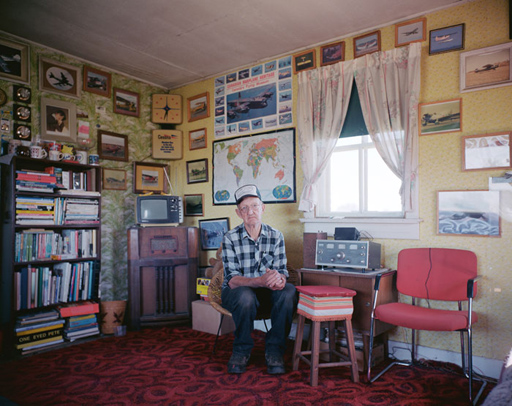
Thomas Gardiner

I enjoyed going through Yale MFA student Thomas Gardiner's project "New York Is Big But This Is Biggar" documenting small towns in Western Canada. As a Saskatchewanian friend always says, "You know we're the same, but a little different."

thomas-gardiner.jpg


Small Victories

I went out on a walk with my 4 year old Gabriel yesterday. "Where are we going?" he asked as I helped him put on his shoes.

"Nowhere, "we're just walking."

"What do you mean?"

"We're going out to wander. It's a beautiful day."

"But where are we going?" he asked again suspiciously.

"Nowhere. Which way do you want to go?"

He pointed towards the river.

We walked and talked. And we talked and walked. We discussed ducks, Louis Armstrong, the nature of rocks, clouds, snowfall, wind, big brothers, blood, girls, trees and a few other things.

Gabriel directed me to take pictures of him standing on various rocks and benches.

At Brooklyn's Pier 1 park, we spread out on the empty lawn and looked at the blue sky. He ran up the hill, rolled down it. He put grass on my head. More talking. Then, a skinned knee after a second run down the hill ended up in the gravel. No. Big. Deal.

We circled back around by the Brooklyn Bridge and passed a neighborhood playground. "I used to go there when I was little." Gabriel looked through the fence, "We found a bone in there once. Maybe some kid died in there."

He wanted to walk by his school (Empty on a Sunday and deemed creepy. "I thought the teachers lived here... It is very quiet now.")

Soon we were back in familiar territory and then home. The four mile wander was over. He ran through the door to find his brother... they started playing/wrestling immediately. No talk of where we had been. No mention of the walk later at bedtime either.

But this morning on the way to school he asked, "Dad, can we take another walk soon? You know, one where we don't go anywhere."

Victory.

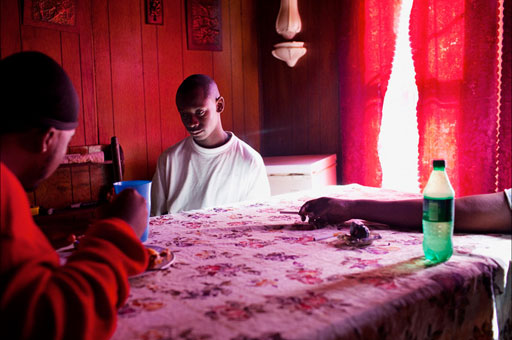
Matt Eich's Sin and Salavation in Baptist Town

matt-eich.jpg

I'm late in discovering Matt Eich's project Sin and Salvation in Baptist Town but I recommend checking it out as he tells a powerful story. This is a long form project exploring Baptist Town, a troubled neighborhood of Greenwood, Mississippi. Eich talks about his work and gives it more context in blog posts (here and here), and in an interview with Joerg Colberg. More images from the project can be found on photoshelter.

Art & Exploration

thewilderness.jpg

An excerpt from Michael Chabon's excellent Manhood for Amateurs:

"What is the impact of the closing down of the Wilderness on the development of children's imaginations? This is what I worry about the most. I grew up with a freedom, a liberty that now seems breathtaking and almost impossible. Recently, my younger daughter, after the usual struggle and exhilaration, learned to ride her bicycle. Her joy at her achievement was rapidly followed by a creeping sense of puzzlement and disappointment as it became clear to both of us that there was nowhere for her to ride it—nowhere that I was willing to let her go. Should I send my children out to play?

There is a small grocery store around the corner, not over two hundred yards from our front door. Can I let her ride there alone to experience the singular pleasure of buying herself an ice cream on a hot summer day and eating it on the sidewalk, alone with her thoughts? Soon after she learned to ride, we went out together after dinner, she on her bike, with me following along at a safe distance behind. What struck me at once on that lovely summer evening, as we wandered the streets of our lovely residential neighborhood at that after-dinner hour that had once represented the peak moment, the magic hour of my own childhood, was that we didn't encounter a single other child.

Even if I do send them out, will there be anyone to play with?

Art is form of exploration, of sailing off into the unknown alone, heading for those unmarked places on the map. If children are not permitted–not taught–to be adventurers and explorers as children, what will become of the world of adventure, of stories, of literature itself?”

(Thanks Larry for lending me the book)

One Year Performance

I never tire of these.

Teching Hsieh created a number of fascinating performance pieces including Cage Piece (1978-1979) where he locked himself in a cage and didn't allow himself to talk, read, write, or listen/watch media for an entire year and Outdoor Piece (1981-1982) where he lived outside in New York City for a year without shelter. Hsieh stopped making art in 1999. Read his Wikipedia entry to learn more.

( via La Boite Verte )

Related: Solargraphs , Alexey Titarenko , Manhattan Bridge , Michael Wesely , Photobooth 1993-2006 , Time Photography , Ahree Lee , Obsessive Photo Projects

New work. Clearing Space. Prints for sale.

raul-gutierrez-print.jpg

I'm printing a new body of work and have to free up some storage space, so I'm selling a number of editioned 20x24, 30x40, and 40x60 prints from my Travels Without Maps series at deep discounts. Most are c-prints. If you are interested, drop me an email at raul.gutierrez@gmail.com and I'll send a price list of what's available.

Update: Thanks for the great response! For the last few prints I have a special offer. In addition to the discounted price I'm offering the option to donate half the cost to The Brooklyn School of Inquiry. That portion of the purchase is 100% tax deductible! Some of the final prints are large ones, so it's a great way to get a large photograph for not so much money. The Brooklyn School of Inquiry is one of New York's 5 citywide G&T schools. It's the only one located in Brooklyn and kids from all over the borough attend.

Question Time

Most nights with my kids after we read books we have question time. Question time is an open forum. The kids have to keep their eyes closed and they can ask any question about anything. It's the favorite part of my day.

Last night:

Gabriel: Will you die if you don't have a brain?

Me: Yes. You have to have a brain and a heart to live.

Gabriel: What about other things like stomaches and arms and eyeballs.

Me: You can live without arms and eyeballs and even a stomach, but life is harder.

Gabriel: What if you have no arms and no legs and no eyeballs?

Me: Then you would need a lot of help.

Gabriel: What about a sore?

Me: A sore? Like if you're leg is sore?

Gabriel: No inside your body.

Me: A sore inside your body, like if you are sick?

Gabriel (frustrated with me):Not a sore, a soua.

Me: I don't understand.

Gabriel: You know a soua that makes you a person.

Me: Do you mean a soul?

Gabriel: Yes. That word is hard for me you know.

[Gabriel knocked out his two front teeth last year and has a problem with hard Rs and words that end in L]

Gabriel: Do you have to have one to live?

Me: Everyone has a soul.

Gabriel: But what if you didn't have one would be a vampire or zombie or something?

Me: Vampires and zombies aren't real, but that's what we imagine people would be like if they lost their souls, but we all have souls even if we forget sometimes.

Gabriel: Where is it? Is it in your head or your belly?

Me: It's just part of all of you. It's what makes you you.

Gabriel: How?

Me: A soul is what lets you feel what other people are feeling. It's what lets you think about other people instead of yourself. People with good souls are kind. Real kindness is hard.

Gabriel: Not for me.

[silence...]

Gabriel: Even Darth Vader had a soul, you know.

Me: I know. Even terrible people have souls, but sometimes they shrink or are hard to find.

[silence...]

Gabriel: What about parrots? Do they have them? Parrots are confusing.

Me: Some people think only humans have souls, but I think animals have them too.

Gabriel: Even parrots? Because sometimes they just say mean things all day.

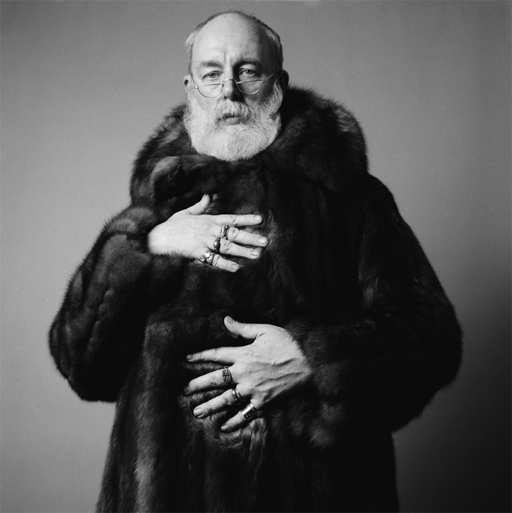
Gorey on himself

edward-gorey.jpg

Photo by Richard Corman
"I really think I write about everyday life. I don't think I'm quite as odd as others say I am. Life is intrinsically, well, boring and dangerous at the same time. At any given moment the floor may open up. Of course, it almost never does; that's what makes it so boring."

-Edward Gorey

Undefined (Part the Second)

A word for things that are equal parts delicious and terrible.

A word for specific feeling of seeing a long lost friend who has forgotten you.

A word for satisfaction that comes from drawing a perfect circle.

A word strange revulsion of hugging someone you thought was a dear aunt, but then realizing it was someone else entirely.

A word for days in which there is an awkwardness to everything.

A word for the strange pleasure of the first few moments in a hot car on a hot day in Texas, and another for the misery of the next few minutes.

A word for friends who used to exist for us in real life, but now only exist in pixels.

A name for the absurd rage one experiences on possessing too many remotes and not knowing which one will switch the TV to the mode you want it to be in.

A word for the exact moment in dreams when we break the bounds of gravity and fly.

A word for the pleasure of opening a book and finding a note in the margin that feels as if it was meant only for you.

A word for the strange symbiosis we have with our children, and and one for the wash of fear when it feels disconnected.

A word for all the things people know about us that we will never know ourselves.

A word for the pause in a room after one speaks out loud of the dead.

A word for seeing the past and the future simutaneously.

A word for looking but not seeing.

A name for all of you people, out there clicking away, reading things like this, thinking; alone and yet together.

Related: Undefined, Concepts that don't exist in English, Words not in English

Richard Mosse

Richard-Mosse.jpg

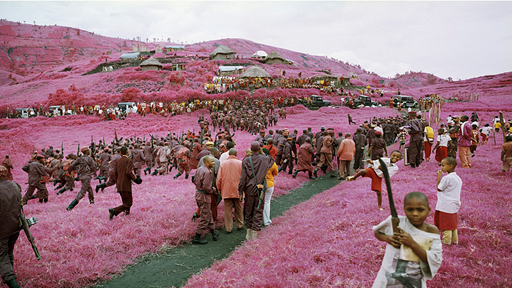
Richard Mosse's project Infra documents conflict in the Congo using Kodak Aerochrome, a discontinued infrared film. The film which renders foliage bright pink, heightens the surreally of an impossible to comprehend war (the Guardian reports 400,000 rapes in a single year and 5.4 million deaths over 10 years) and forces us to re-examine conflict images. When I first heard of this project (without seeing the images) I dismissed it, but the images are powerful—they would be without the exotic film stock. Mosse is a thinker who gives eloquent explanations for his choices. Ultimately Mosse does what good photographers always do, he forces us to look closely and reexamine what we think we know. (via Aperture Magazine)

Archive

1999 — 2026
2026
Jan Mar Apr May Jun Jul
2025
May Jun Oct
2024
2023
2022
2021
Jan
2020
Mar Apr May Jun Jul Oct Dec
2019
Jan
2018
Apr
2017
Oct Nov
2016
Mar
2015
Dec
2014
Oct
2013
Mar Apr May
2012
Jan Feb Mar May Jun Jul Aug Sep Oct
2004
Mar Jul Aug Sep Oct Nov Dec
2003
Mar Apr
2002
2001
2000
1999
May