Denis Dailleux update

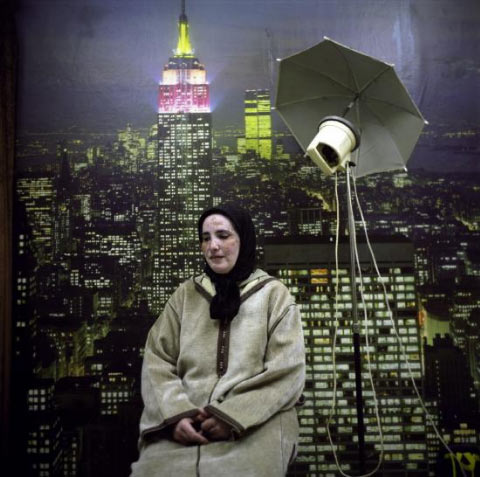
I pointed to Denis Dailleux's Cairo work last year. I'm happy to report that this excellent photographer now has a new website with many more bodies of work online. If these images don't inspire deep wanderlust, well, you just don't have wanderlust.
Last Year's Entry: Cairo
Graciela Iturbide

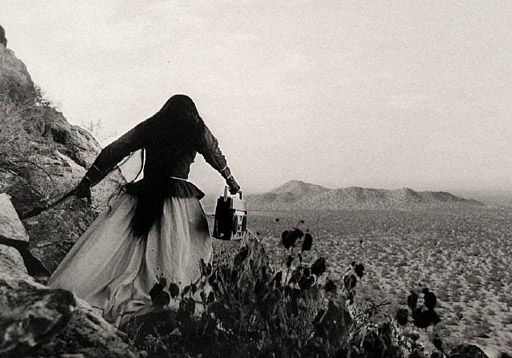
My grandfather made ladies shoes. He didn't physically make them himself, he would cross the border and buy good ladies shoes in Laredo and then have a network of local leather men and cobblers make meticulous copies which he would then label with his Rudy brand (He was also a loan shark on the side). Everyone said his shoes were better than the originals. The leather was better, they lasted longer, etcetera. So some days he would drive around Monterrey and meet with men who tanned leather, cut leather, or dyed leather or who stitched shoes, or fitted soles, or manufactured shoe boxes. Some days he would drive around to the various shoe stores in the surrounding villages making deals for his shoes, and some days he would collect money or collateral from the people who owed him. I used to love to make the rounds with him always up front in those big wide seats of his 70's era Cadillacs or his stylish Ford Elite listening to Pedro Infante on the radio. We covered hundreds of miles on our summers together crisscrossing Monterrey and 50 miles in every direction. My memory of that time is dreamlike. This was pre-Nafta Mexico in the 70's before everything started to look like everything else and many of the things I saw burned into the brain forming the foundation of my visual memory palace. I mention this, because Graciela Iturbide's images remind me of my memories and recalling people and places I saw on street corners and in markets maybe for a few seconds but who were unforgettable. There is not one good site showcasing the range of Iturbide's work, but you can find some of images here and here. If you are really interested, her books are a better bet.
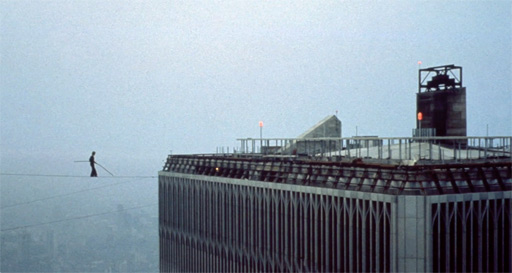
Man on a Wire
Still from the movie
I saw Man on a Wire last week and the documentary has lingered with me. The film has several annoying elements: the main character is basically a mime (he's not actually a mime, but let's just say he has a mime-like personality, and who among us does not discriminate against the mimes), the film uses cheesy low-fi reenactments mixed with archival footage (a technique more suited to television than film), and the movie has been overpraised (always suspicious), but despite all that I can't deny the movie's resonance. It's a tale that touches on the act of creating art, mortality, creation, destruction, and ultimately vanity and betrayal which is more than I can say for most films I've seen recently. The filmmakers never mentioned 9/11 as the connection is implicit: the planning that went into this performance was the poetic inverse of the planning that went into the towers' destruction and perhaps this is why the film inspires such emotion in its audiences (many in our audience jumped to their feet and clapped at the end). A. O. Scott wrote in his New York Times review,
"It is easy to imagine that, in contemplating the scale and solidity of those brand-new towers, Mr. Petit saw them at least partly as the vehicle of his own immortality (whether or not he survived the crossing). No one looking up at the New York sky on a hazy morning 34 years ago and seeing a man on a wire could have suspected that the reverse would turn out to be true."
Go see this film if you have the chance.
Related: Philippe Petit's Wikipedia page which includes scans of the the famous New Yorker covers he inspired. Also read Paul Auster's Red Notebook which contains a great short story inspired by the walk.
. . .
While browsing around for this article I found a neat little homemade site called Walking Art with many examples of epic walks. The site fails to include the great walking artist Hamish Fulton who is an artistic inspiration and whose family has been very kind to my family.
Your Name, Pomologist
They are building a building in the vacant lot next to the firehouse we call home. Rather they were building a building. One morning 2 backhoes trundled in and dug a hole about 15 feet deep and 20 feet wide. Workers put up a big fence blocking the lot from the street, and then everyone left. The diggers rumbled away and the lot has been quiet ever since. Two months have passed and... nothing. We have back door onto the lot so we can go out there, not that there's anything to do. If we were smokers it would be the type place we would excuse ourselves for a minute or two to have a cigarette.
I don't smoke, but I do eat plums and drink coca cola. My family has been visiting my mother in law all week leaving me here alone. You can live alone for 20 years and never notice silence, but after 4 years of marriage and 3 years with kids, the silence is heavy. So all week I keep finding myself venturing outside with a coke or a plum in one hand and chair in the other. Tonight it was a plum.
People who study plums trees are called pomologists (Pomology is the study of fruit trees—not specifically plum trees). Can you imagine how great it would be to have a business card reading Your Name, Pomologist. (I've always imagined the Pomologists have an intense rivalry with the Olericulturists who study vegetables and who take pomological abuse in silence: "You study the radish?! Celery?! Cucurbits?!! Live man, for once in your life, live! Get your head out of the dirt and consider the glory of the peach and the pomegranate! Persimmons! We KNOW the persimmon. Go now, enjoy your arugula. Be gone.") Many Pomologists think the plum tree originated near the Caspian Sea in the Caucasus Mountains, but nobody really knows for sure. I've seen plum trees in the Hunza valley in Pakistan and a man there told me his valley was the site of the Garden of Eden and that it wasn't an apple that Eve ate but a plum. He also claimed to be the bastard son of the Mir of Hunza and to be one hundred and three years old, but that's another story. Anyway, I was sitting there in the dark, I ate my plum, and then I said out loud to no one in particular, "There are sweeter things." With that I finally felt the day was done and it was time to start dreaming of tomorrow when the house would be quiet no more.
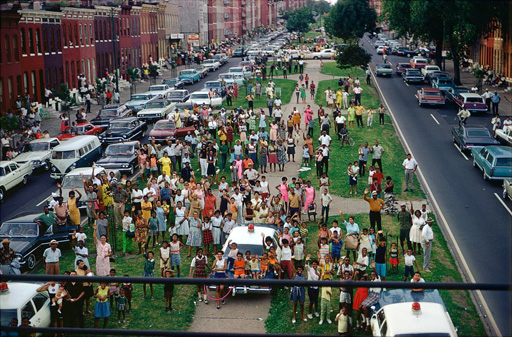
RFK coda

Untitled (Baltimore) by Paul Fusco
by Martin Johnson
As sort a quiet coda to Paul Fusco's profoundly moving RFK Funeral Train Exhibition which closes this week at Danziger Projects, Square America (a photographic ephemera site) released a set of found pictures of RFK's funeral as seen on television which the the site has titled What Was On (June 1968). I was one year old in 1968 but the pictures evoke images of my childhood living rooms, some of my first memories. Both sets of pictures in very different ways evoke the emotion of that year and need of the photographers to hold on to those emotions.
If you didn't get a chance to see the Fusco exhibition first hand, Aperture is re-releasing an expanded version of his book. It is available for pre-order. I can't wait for mine to arrive. The Square America guys are releasing their own book titled "Who We Were: A Snapshot History Of America", no pre-release link yet.
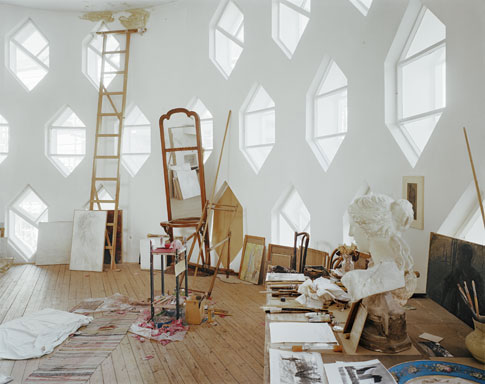
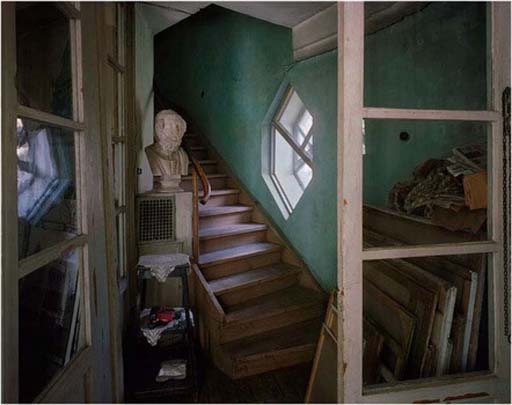
Richard Pare, Russian Avant-Garde Architecture, and the Melnikov House

Every year or so I look for an excuse to blog about Konstantin Melnikov's architectural masterpiece, his own home. This year's excuse is that house now has it's own website: Melnikov House and that Melnikov's wikipedia page has been considerably beefed up with many good links including one to the Russian Avant-garde Heritage Preservation Foundation (which led me to the excellent Russian Utopia Depository of Paper Architecture). This web meander started because I was looking at Richard Pare's work online. Pare spent 14 years shooting architecture in Russia for his celebrated book/exhibition The Lost Vanguard: Soviet Modernist Architecture, 1922–1932.
You can read more about Pare's work in the NYTimes or via this interview. Also of interest for Melnivkov fans is this obituary of his son Victor who was a well known painter. Now off with you until next year when I'll be back with more Melnivkov updates.
6AM with Gabriel

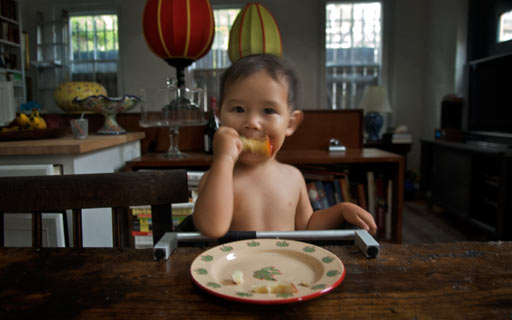
1. Bite the apple.
2. Pass the apple.
3. Wait for a bite.
4. Receive the apple.
5. Repeat steps 1-4 until done.
6. Break open the core.
7. Consider each seed.
8. Go start the day.
--
The same but different: First Hour, Eating Apples
George Eastman House Autochrome Collection


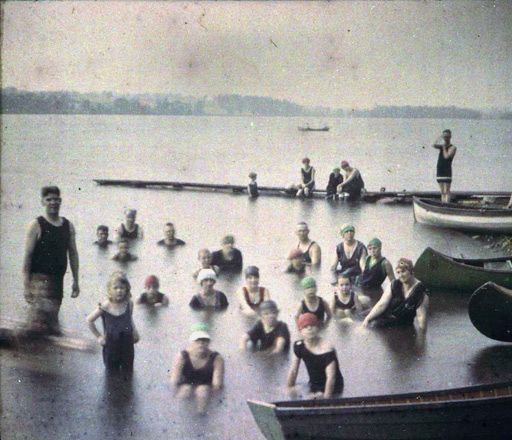
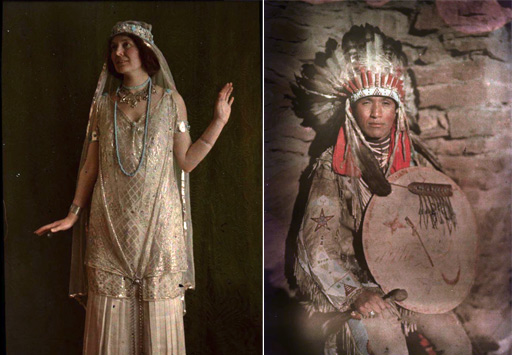
The George Eastman House has joined the flickr commons and has included a set of early 20th Century autochromes which have been a source of fascination and inspiration for years.
Flickr Commons is a fantastic idea. My wish is that the whole thing could be taken further. Imagine an open source version of flickr dedicated to showing artwork and photography from public institutions in which users had the opportunity to contribute scholarly work or to group images into collections.
Note I did a quick and dirty color correction to the images I've posted above.
Related: Early Color Photography
Approaching Coney
Erica Cho
Are You Me? (03 Hangul) from aufdemweb on Vimeo.
My wife's cousin Erica is a video artist. I love this video which is part of a set video poems between herself and the artist Xana Kudrjavcev-DeMilner.
Eric Newby on Meeting Thesiger

When I was a teenager my heros were great travellers like Eric Newby and Sir Wilfred Thesiger. The Guardian has a short account by Eric Newby of meeting Thesiger on the road. Jeremy Sutton-Hibbert who pointed to this link also provides his own account of meeting Thesiger as well as many good links.
Related: Eric Newby
Overheard in the Elevator at 195 Chystie
Girl on phone: Why? So you can go home and read Vonnegut and be depressed?
Girl on phone: (Long Pause from 9th floor to 4th floor)
Girl on phone: Oh. My. God. Martin you are not being artistic you are being antisocial and gloomy. LIKE ALWAYS.
Girl on phone: You stay home with Kilgore Trout. I'm going to a party. I'm eating ice cream. I'm going to join the human race. Goodbye Martin.
Kate Orne

It's hard to image a more hostile working environment for a Western female photographer than a Pakistani brothel, and yet photographer Kate Orne has managed to make a series of compassionate even tender photographs in red light districts there. Powerful stuff.
Virgilio Ferreira

Portuguese photographer Virgilio Ferreira's portfolio Daily Pilgrims is one of those projects that sort of snuck up on me. I looked at it a week or two ago and have kept coming back to it. I'm not sure if this will make sense to you (it does to me), but the portfolio evokes the memory of the memory of stepping off a plane into a new and foreign city full of too many new sights and sounds to be processed. When you remember back everywhere there were fleeting glimpses of untold stories, but in being a memory of a memory wires get crossed—in the overload details blur leaving an evocative impression without actually describing the specifics of the place.
(via his Hey, Hot Shot! entry)