It was 17 years ago on this night that my mother believing my youngest brother’s sickness was incurable shot him and then shot herself. That is the simplest way to tell the story, the facts of which are as stupefyingly shocking today as they were when I first heard them over the phone on January 2nd 1990. Our maid had discovered them.
I was sitting in an office in the Citicorp Building in New York City when I got the phone call. I was four months into my first post college job. It was 10:02 in the morning. There were three calls actually, the first two were the sounds of someone wailing. Not understanding what was going on I hung up twice. When I finally answered I felt as if someone was turning a knob forcing all my senses into an uncomfortably accute range. I could feel the air on my fingers, hear the sound of the wind on the windows, see the minute hand of my watch move second by second. It was as if all the filters allowing me to tune out distractions were ripped from my head. Preternaturally composed, I made flight arrangements to Texas. Then I walked down the hall and told my boss the story and said I would be leaving for a while. My boss followed me down to the street, flagged a taxi, and told me to take as much time off as I needed. I saw him standing there with tears in his eyes as we sped away. A friend and his girlfriend met me at my apartment. We packed in just a few minutes, but the flight wasn't for a few hours. Not knowing what to do we killed time at coffee shop on Lexington and 78th before heading to Laguardia. In the cab we didn’t talk. I kept thinking back a few day to when a black balloon had appeared outside my office window on the 53rd floor lingering there in the air seemingly in defiance of physics. It had floated away horizontally. My mind was turning slow irrational somersaults. "There must have been some horrible mixup," I thought, "none of this makes sense."
I was wearing an old shirt with buttons thinned by wear, and on the flight I remember rubbing the buttons between by thumb and forefinger. The facts were what they were of course and when I arrived home late that afternoon to a houseful of family and friends all in various states of anguish it all hit me like a sledgehammer. I first went to my grandmother kneeling before her and wrapped my arms around her. "I don't understand," she whispered in Spanish, "why?" That night I couldn't sleep and felt the need to write something. The first words that came out were: "I realize with profound clarity that we have choices. The type of life I will live is determined by the choices I make. Starting now."
In the coming days I immersed myself in the bureaucracy of death, getting police reports, ordering official documents, canceling credit cards, arranging the funeral... I remember a funeral director wearing a tieclip in the shape of a shotgun. He said, "Don't worry son, we all have pain in our hearts eventually." This was Texas after all. Having something to do was easier than trying to explain the question everyone kept asking. "Why?" I didn't know why and what I did know—my certainty that this was an act of extreme empathy born of blinding if perverse love—was unmentionable. Too difficult for others to hear or for me to say.
The police report said that my brother died instantly, but that my mother was probably alive for some time, maybe up to an hour before finally bleeding to death. She had missed her heart. That hour haunted me. I had been hit by a car as a 13-year-old and remembered vividly what it was like to lose blood and go into shock. The mind is not turned off in those moments, instead there is a brilliant clarity as in a dream, but the body is immobile and helpless. Was she wracked with regret and doubt, did the terrible folly of it all come crashing down on her? Did she think of us?
When you experience tragedy, someone will inevitably tell you that time will heal you by scarring over your wounds. But time becomes meaningless when you lose the people you love and sometimes you don't want to scar. The rawness of tragedy opens you up as a human being allowing you to feel as never before both the good and the bad.
It was almost two months after all this happened when I finally arrived back in New York on a late flight. My cabdriver was playing a Charlie Parker tape and despite the crisp February air, his window was rolled down so he could take drags from a cigarette. As we drove over the 59th Street Bridge clouds parted revealing the thinnest sliver of a new moon hanging over a glistening city. The vision of the city filled my eyes with tears. "I choose hope," I said to myself, "I'll be ok". Half a lifetime later I can say I was right. The question I sometimes ask myself on January firsts is, "Is it possible to fully enjoy the deep sweetness of life without tasting profound sadness." I don't know the answer but I ask it every year.
related: 1/1 2005
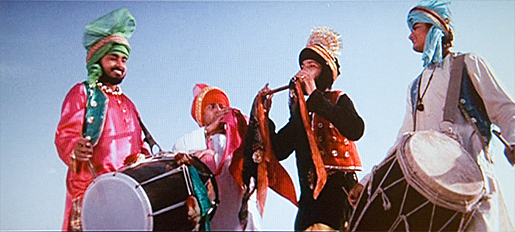
My Korean mother-in-law apropos of nothing:
"You are soooo lucky. Your new baby will be a pig. Not any pig, special red pig, once every 60 year pig! Jenny is cow. I am mice. What year were you born....? 1967? Hmmm. You are sheep. Oh sheep not so good.... but you are lucky to have pig baby soon. I told people in my church and they say you are full of blessing. Some Koreans think pig year is so good thing they have two babies in one year. Really. Pig people get a lot of property, money. Everything. They are sooo lucky."
related: Mrs. Yunnisms
1. Do more serious astronomy.
2. Cut more grass = Buy more records.
3. Build a pulley system in the fort.
4. Develop a network of hiding places.
5. Learn 6502.
6. Run more.
7. Hit some home runs!
8. Study the Aztec and Olmec civilizations.
9. Take black and white pictures of everybody.
10. Write down funny things that happen.
December 31, 1978 10:32PM
related: 10 wishes for2006
I was driving down Flushing Avenue near the Brooklyn Navy Yard tonight when I passed a friend biking down the other side of the street. If you don't know it, the Navy Yard is sort of a semi-abandoned walled off industrial area. It features ruined mansions, the parking lot where police tow cars with too many delinquent tickets, and some sort of sewage treatment plant. Anyway, at night whole area is pretty deserted so I slowed down and shouted over to my friend as he pedaled along at a furious pace. I yelled hello and drove off but he soon caught up to me at a red light. Through the open window I asked after his wife who is pregnant and he said he thought she might give birth tonight or tomorrow... He said he looked at her this morning and was just staggered. We forget what those last days of pregnancy look like. She's due. Overdue probably. He was rushing home and after that brief exchange he zoomed off at full speed not bothering to stop for the lights...
It's a very specific feeling— knowing your wife is on the cusp of giving birth. I used to use the analogy of being in an airport, heading off for a big adventure, but being on hold, waiting for a flight that you know will come, but that keeps being rescheduled or sometimes I would use the analogy of being a kid waiting for Christmas... But these descriptions are thin soup compared to the complexity of the actual emotions. And for the woman the physicality of pregnancy and birth adds dense layers of hard to define feelings to the whole thing. My wife Jenn isn't due until the end of February but already tiny hands, feet, and elbows push out from her belly. That supreme intimacy with another human being can be profound and overwhelming all at once. She's ready to have the baby tomorrow. That's the thing with the second baby. Jenn is ready. Enough already she says.
We dads have it easy. We worry a little. We try to keep things under control. But mainly we ride our bikes in the dark as fast as we can hoping for the best.
related: a post titled circling from before our son was born (note: at that time we thought we were having a girl). It would be another week before he was actually born.
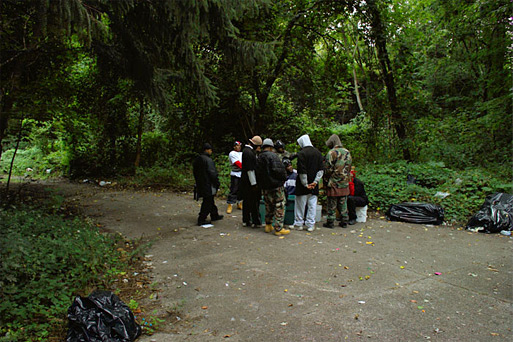
I've been a fan of Dylan Chatain's photography since I saw a few of his prints at the Jen Bekman Gallery last year... He's recently posted more work online from project The American Imagination. When I saw his prints lat year and when I checked his work online, the phrase that kept floating into my head was quietly evocative... but instead of reading a description, why not just look at the pictures...
Pentagram Design, as usual, sent out a memorable holiday card. This year it came in the form of a booklet, "The Alphabet: A Critical Assessment", a printed copy of a Marion Bantjes blog post.
on the upper and lowercase Z: "And last, but certainly not least, the Z, with a final flourish, a sword slash (I know!), a signature of completion. The Z has exhuberance and balance ... alas, with the lower case z, the alphabet goes out with a bang and a whimper."

James Brown: Christmas in Heaven
Posting will be sparse until after the holiday.... I trust you all will pass it well.
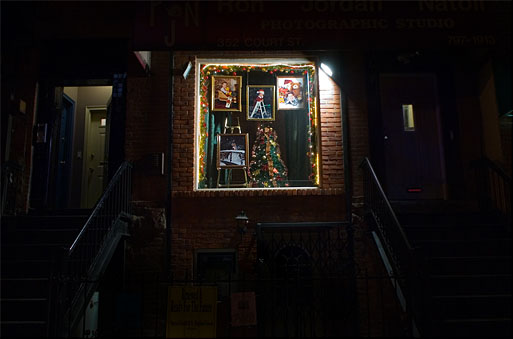
related: same window
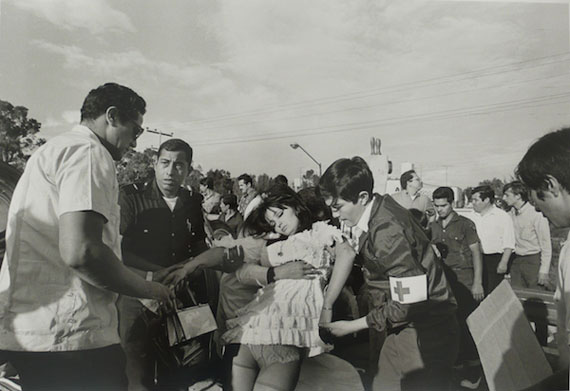
Mexican crime photographer Enrique Metinides' work often leaves viewers unsettled. He is compared to Weegee because of the macabre subject matter and yet Metinides work strikes a darker chord. We look at Weegee's dead mobsters and think they got what they deserved, but when Metinides shoots a kid floating on bottom of a pool the tragedy is palpable...this could be someone you know. Reviewers always compare Metinides photos to film stills maybe because he shoots wide tableaus including bystanders—passersby frozen in a moment of contemplation—this gives the images a larger than life reality that competes with the unreality of the subject matter and distinguishing the images from common tightly composed flash-bulbed newspaper pulp (as an aside it's an effect many art photographers especially those from the Yale school of photographic thought keep trying to replicate). Many of the pictures are hard to look at and yet you are drawn to them. This is not exactly rubbernecking, it's a more primal pull. These are views of death that carry the shade of hard reality. We viewers become bystanders ourselves.
Today the New York Times is featuring a review of a Mentinides show up at Anton Kern Gallery through January.
Andrew Kern
532 West 20th Street
related: another good article on Metinides
Other shows I want to check out this weekend:
Girls Room featuring work from some 30 odd artists...
@ Jen Bekman
6 Spring Street
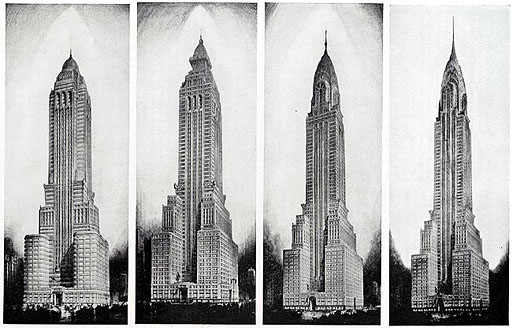
These were a few of the proposals for the Chrysler Building by architect William Van Alen... Apparently the Chrysler board liked the 2nd proposal, but Chrysler himself didn't think it was modern enough, and pushed the architect to do better eventually leading to the final design. The final decision was made by two men: Chrysler the client and Van Alen the architect with no committees or boards to dull the boldness of the design. Architectural critics of the day hated it by the way which tells you a little something about architectural critics.
Every time I see the Chrysler building from afar I literally hear music in my head... sort of an low chord under an angelic "ahhhhhhh....". This happened the first time I saw the building in person at the age of 4 and it happens today. I hope it never goes away.
related: salon on the building's history, Metropolis of Tomorrow, dentist in the Chrysler Building.
In small towns, like the one in which I grew up, you can often go weeks without running into a stranger. You know people's stories and they know yours. You find mystery by picking up on dissonance between the facades people present and the realities underneath... But in big cities virtually everyone you encounter in a day is a stranger. You pick up little snippets of conversation, see bits of urban drama, but you always catch the stories in the middle. And the beginnings and endings are left to the imagination. Why was there a man in a black overcoat and black sunglasses standing alone on the promenade holding a child's pinwheel? What happened to the young couple fighting on Cranberry street? Did he mean it when he said he would change? Change what? Did she believe him or was she going back to her mother's house in Connecticut as she had threatened? Did the young thief being chased down Atlantic Avenue by cops escape with his loot from the pharmacy? And what of the very old man who wanders the neighborhood with a little camera around his neck? What does he do with those pictures he takes so unobtrusively, unnoticed except by other photographers? Does anyone ever get to see them?
related: photographs I did not take today, unphotographable, urban drama

I see this man around the neighborhood several times a week. He always carries a dog eared book in his big hands. I've never seen the same book twice.