Some of my photographer friends have asked for some geeky photo notes... The rest of you can ignore this post.
Let's see.
I brought my FM3, D70, Mamiya 7, and Polaroid SX-70 Land cameras, many more cameras than usual (but only one lens apiece). I was going to try to primarily use the Mamiya 7, but have found I don't work fast enough with it and have generally only pulled it out for landscapes and static shots. Also the Mamiya is large and intimidating. Not good when dealing with people wary of cameras to begin with.
The D70 emerges at night or when I'm in someone's house or yurt. It's also too big and I haven't found a lens I love for it. The FM3 w/ 24mm lens has been my primary camera. I've been using FM2's since high school so it's what feels most natural for me. It's small, unobtrusive and I shoot very fast with it.
I give away the polaroids. If I hang out with a family or take someone's picture I like to give something back. Many of the people around here only have a few photographs taken in a lifetime, some have no photographs at all...so the polaroids are a big deal for them. I brought 20 boxes and have 8 left. The problem with the polaroids is once you take one everyone in the village wants one, so I try to wait until I have the person one on one, take the picture, and move on.
I brought 35 rolls of color 35mm (mainly plain old Kodacolor 100), and 15 rolls of b/w 35mm (plusx and tri-x). I've almost gone through all the color (I think I have 3 rolls left). I've shot about 1/2 the b/w. When I exhaust the 35 I'm going to start shooting my 220 film (mainly NC160). Perhaps it will force me to quicker with the Mamiya.
What else... With the D70 I brought 2 4gig cards and 2 1gig cards. I've filled one 4 gig card. All shot RAW. Mostly hand held night stuff with the iso pushed up to 1600 and interiors.
I've shot much more on this trip than I have on previous trips. There are 3 main reasons. 1) I've now actually looked at the film I shot on previous trips which in a weird way has given me some direction, ie projects. 2) Shooting with the D70 has made me less cautious and freer to experiment (perhaps also a bit sloppier) 3)I'm traveling by car and can stop wherever I want. Previously I was always on public busses and passed many of the people and places I wanted to explore.
One final note. I really miss the simplicity of the FM2's plus minus metering system. The FM3 moved the display over to the left side of the screen and added shutter speed information. This is perhaps more accurate, but for me it goes against the simplicity of that makes this series of cameras such favorites. Also moving the display over to the other side of the screen makes me crosseyed. Westerners read right to left and I expect the display to be on the left. On the plus side I appreciate the really long metered exposures now possible with the camera, and apeture priority is helpful in a pinch even though it feels like cheating.
I think that's it. Let's see how the pictures turn out.
Mainland China is home to some of the world's finest hotels. This post is not about those establishments, this post is about the average small hotel you will find in just about every city, the kind of hotels regular Chinese people endure daily.
Generally the hotel is in a courtyard set back from the street. White brick tile and blue tinted windows are de-rigor. There will be brass pillars at the entrance, and elaborate chandelier, and smartly dressed women behind the reception desk. On the wall, many clocks with exotic world cities. But look a little closer, none of clocks are set to the correct time, some of the city names are missing letters, and that chandelier, it probably doesn't work and there is a leak stain around it's base. The women's uniforms don't match and are often dingy. But still the lobby is presentable, and tidy despite the four guys smoking, drinking bai-ju, and spitting sesame seeds in the corner. Ignore the wilted plastic plants. Now walk up the stairs to your room. The hallways are covered with grimy handprints. Electrical fixtures are missing. There are strange leaks running down the wall leaving a streak of mould. Someone has put up a large poster of a random city (not the one you are in), but the frame is broken and the poster is faded beyond recognition. Again more wilted plastic plants.
When you get to your floor, you will have to wait for a fu-yuan, a chambermaid, to open the door. The fu-yuans are rarely more than 19 years old, and are often in their rooms watching TV, doing their nails or enjoying an illicit cigarette. When the fu-yuan finally arrives she will glumly lead you to your room and open the door, that is if she brings the right key which she often doesn't. Every fu-yuan I've encountered on this trip has had a nasty cough.
The room is grim. Bedsheets that have been straightened but not changed or washed. Odd stains dot the floors and wall, cigarette butts, and hair--Long black hairs on the pillows short curly hairs on the curtains. The light fixture is always at an odd angle. There is no shower, sink, or toilet instead a mug of hot water is helpfully provided. The water smells of coal.
The bathrooms are a disaster. I needn't go into the details for fear of offending my more sensitive readers, but imagine the worst thing you can imagine in a bathroom and it's worse. Usually bathrooms = squat toilets or a trough, not showers.
If you are lucky there might be a paid shower downstairs near reception. In today's hotel the shower stalls were a long walk past filthy massage rooms and a half-collapsed sauna. The smell of mould was overpowering. Again, coal scented water. Still, the shower was a blessing, most places do not feature such luxuries.
Wandering around the hotel you will find random groups of men playing cards in the lower rooms, the doors slit open. There are always a couple of police around, often chatting up the girls. Upstairs there is a disco complete with disco ball. Here the fu-yuan and other hotel ladies dance with each other. Eventually men (sitting in groups or 3 to 5 smoking cigarettes end to end and heavy drinking) call over a girl or two and negotiations take place. They disappear in pairs.
Sleep is difficult, between the pounding music, the smell of the bathrooms, and the uncomfortable beds you are lucky if you get a few hours.
And these are the nice hotels. Guesthouses, are another level of "real".
This is not a complaint. I accept this as the reality of travel around China's non-touristy cities, but it's a counter to those who fear China's economic might will subsume the West. Much of the China foreigners see along the East Coast is something of a Potemkin village. Scratch behind the surface even in Beijing or Shanghai and you will find masses of people struggling with the basics. Potable water, simple sanitation,low-level cleanliness. Something to think about the next time you read about the powerhouse that is China.
One question that keeps coming up via email is "How in the world are you getting internet access?" Believe me, it's strange for me to. In this part of the world modernity/technology is a mishmosh. All day long today we passed great stone Tibetan houses with satellite dishes on the roofs. The people in those houses work in the fields with horses and yaks doing hard manual labor (and use outhouses) and yet they have cell phones. Some nomads have solar panels which they use to power TVs and radios.
Internet access is limited to medium sized cities like the one I'm in now. Let me describe the where I am: The room is dark and grimy and has about 60 computers crammed into 3 rows--old no-name PCs with even older 13-14 inch monitors, all different brands. The chairs are plastic, again none matching. There is a forest of wires on the walls and ceilings connecting everything together. Most of the people in the room are kids playing Warcraft. Over in the corner there is a young monk playing Half-Life. 2 of his monk friends encourage him over his shoulder. One guy silently surfs porn. Another watches an anonymous Charlie Sheen movie. Most of the guys in the room are smoking. Outside men in cowboy hats roar past on motorcycles. An old woman leads 2 baby yaks down the street and lots and lots of monks wander around with their hands behind their backs. There is a heavy police presence. The PSB guys generally tool around in SUVs with music blaring from the windows. Sometimes nomads from out on the range peer in and stare, but they are more interested in the Tibetan movies playing on TVs in virtually all the restaurants here.
In the next few days I imagine we will be beyond the reach of the net. We will be staying at monasteries and in some very small towns. But you never know. Today we spotted a monk with a camera phone receiving pictures from one of his friends who was out on pilgrimage.
. . . . .
We had a very nice drive today. The road from Xinlong to Ganze follows a river up the mountains and all along the way are villages of massive stone houses. Each village had it's own particular architectural style and each was spectacularly situated, one more impressive than the next, over gorges, on mountainsides, or hanging over the river. Near the end of the day the valley widened out into a huge plain full fields of wheat and barley. Women worked in the fields and I was reminded of Millet's painting "The Gleaners".
Ganzi the town has changed a great deal since my last visit. Most of the log cabin style homes have had concrete facelifts, but the town maintains it's funky appeal. Up in the mountains above a huge modern monastery rebuilt on the ruins of the old one destroyed during the cultural revolution. My favorite part of the day, visiting the school where the monks "fight" with each other. In a big courtyard full of fruit trees about 100 monks were "fighting"... they were in pairs one on the ground the other standing, and would shout and try to intimidate each other with superior arguments and forceful gestures.
We had many other adventures today, but I'm tired of this keyboard (many of the keys are not in the standard place so typing is a pain)... Time for a beers in another Tibetan disco.
If you ever want to experience the early 19th century American West, I suggest taking the road from Litang to Xinlong. Along the way you will see tens of thousands of yaks (think buffalo), hundreds of yurts (teepees), and all manner of things that were supposed to have vanished long ago (men on horses with flintlock rifles strapped to their back for example). After climbing and crossing a pass you descend into a deep old growth forest so thick with trees it brings to mind the brother's Grimm. I recommend it.
After those valleys you cross over into an area unmistakably Tibetan (no longer western feeling, but no less 19th century) with large stone homes hanging on the sides of deep river valleys.
. . .
Xinlong is a medium sized semi-modern Tibetan city. There are two major monasteries nearby. We went out to the Bon Black Sect monastery and were escorted around by an older monk. He led us into one of the inner chambers where a young lama was sitting on a throne counting money. On the floor below a black bunny rabbit hopped around with impunity. We were told not to eat rabbit and were given small packets of herbs. It was all a bit odd.
When we exited we ran into a funeral, a Tibetan woman stirring a funeral pyre and weeping inconsolably. On the steps of the monastery about 200 monks were chanting. It was quite a scene.
I've been having intense dreams. Always happens at altitude. Perhaps more on that later. Right now I must escape. Internet access in China happens in dark smoky rooms and the smoke is killing me.
People ask me why I keep coming back to this part of the world. Here are a few reasons from the last 2 days.
-Happening on a flower festival in a nunnery where hundreds of nomads descend from the hills with flowers, offerings and reminders of all the beauty in the world.
-The scribes who sit and dictate letters for those who cannot write.
-Watching a thunderstorm from above the tops of the clouds from 4600meter pass, lightning filling them every minute or so.
-The big khampa guy on the motorcycle with 4 big yak legs tied to the back.
-The local english teacher who inspired us with the stories of her students.
-The goat skewers i will eat in a few minutes.
-The knife thrower and the flame eater on the street outside.
-just about every tibetan disco.
-The mom chasing her son around the yard with a yak tail.
Those were the words shouted by a soldier at the front of two long lines of soldiers who stood on both sides of the stairway descending from our plane that had just landed. The jet sat alone in the middle of an empty tarmac. Steam hissed from stadium lights that were all around . The year was 1986 and I was visiting Beijing for the first time. I was 19 and traveling alone with money I had saved working at the school library. My reason for going, a girl had asked me what I was doing for spring break, and I thought it would be fun to say I was going to China. Once I had said it I was committed. That little bit of arrogance would forever change the course of my life.
The Beijing airport had the ambiance of a small funky region airport. The wooden luggage conveyer belts click-clacked loudly. Nothing worked very well. There were lots of soldiers all around. Upon exit there were no shops or restaurants or people coming up to you saying "axi Taxi Mr.", just guys in white shirts chain smoking with grim expressions on their faces.
The road to town was dark and dusty. There were no street lights so the only illumination came from our headlights which did not cut deep into the dust. Once we left the airport gates both sides of the road were lined with tall trees with long limbs that made weird shadows as we passed... and there were the bicycles. Our van was virtually the only motorized vehicle on the road, but there were hundreds, if not thousands of people on bicycle, lights illuminating their backs as they parted to make way. I remember thinking the people reminded me of fish in the Caribbean... It was that way for miles all the way to the heart of Beijing, past Tiananmen and to my hotel. I quickly stashed my bags and walked to the great square nd sat for a long time watching the sea of humanity cycle past as the wind kicked up. There was an incredible romance to it all and I remember every detail.
I have been back many times since and each time the city has offered me something new. A few years later that low slung bicycle laden city became a giant construction site full of people on motorcycles. Today it is a modern metropolis. Arriving yesterday at the busy airport I was struck that the first thing I was greeted with as I exited customs was a Kentucky Fried Chicken. It is easy to get wrapped up in the nostalgia for the past and what was and what has been lost in the rush to modernization but I find that prevents me from enjoying what is here and now... Even on my short stay Beijing has offered plenty of surprised... but I am late. More on that later.
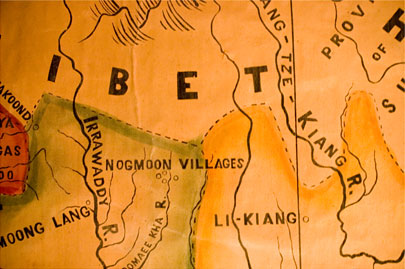
After so many years of tormenting me on the edges of my big map I will know you. My eye has found you on so many a night way up there perched above the French sounding Tati and the exotic Tali-Foo, on the edge of the edge of what was once known. Of course Nogmoon is not your real name, just the fantasy of some 19th century missionary, but a missionary with an ounce of humor. Humor enough to christen a dreary fly-blown city with an unpronounceable Mompa-language name Cuddleme, a name so appealing I spent 4 days and 4 nights trying to track it down only to arrive and be told the flies were "too heavy" and I must go to the next town to eat. Experiences in the equally prosaically named Busta and Jelii Jeli tells me you Nogmoon might be nothing, just another Chinese garrison on a dusty road to nowhere, but just maybe you are something amazing and so very soon, off I will go to uncover your secrets.
I'm almost out the door on my way to Litang and beyond, but I've been so swamped with work I haven't had a moment to think about it. Hard to believe in a few short days I will be here. Ok, enough of this, now back to work. Must finish project by tomorrow.
If you are into street photography, you have probably already bookmarked, the always compelling quarlo.com. Slightly more obscure, but no less rss-worthy is Yamasaki's site. When they have new pictures on their sites, I always say to myself, "Ahh the Great Quarlo" and "Ahhh... Yamasaki the Great" and then they always deliver the goods.
I hate a great many things. I hate it when people say "have a good one". I hate cats. I hate renting and I hate humidity. I hate mosquitoes, people who call me chief, and the way cereal gets soggy so fast. I hate Mac Word 6.0, Karl Rove, and bad fonts. I hate Costco and PC Richards. I hate my forgetfulness. I hate rats (they scare me to death) and bureaucracy and that kid named Bill who spit on me in the 5th grade (I pegged him with a rock a few weeks later). I hate cleaning hair from drains, golf, Lance Armstrong bracelets, and the death of punk rock. I hate my clothes. I hate anything with coconut, the letter q, and the robber took my grandfather's chest full of photos. I especially hate losing friends over time, and the fact that Elsie's Oke Doke Pub on 84th between 1rst and 2nd is now closed. I hate not having sent all those wedding gifts and that I never write longhand letters anymore. I hate hate hate many of my friend's taste in music, a scar on my leg, and the inevitability of death (not my own so much, but of the people close to my heart). I hate not having a garden for Jenn to garden in; I hate no longer caring about baseball; I hate eggs. I hate the guy who went out of his way to blackball me from a club in college, direct overhead lighting (I prefer lamps), white walls, and the sound of my voice when recorded. So many things to hate in this imperfect world... People who know me will tell you I hate most movies these days. But I saw a movie I loved tonight. It's called, Me You and Everyone We Know by Miranda July and I think you should see it because when someone makes a great little film, or writes a book that moves you, or makes music that gets you dancing, there is, at least for a moment, a little less hate in the room and that can't be all bad.
In response to a couple of emails and a comment on the blog, here is my 2 cents on how to travel to Tibet cheaply:
1. Realize that Tibet is not just the Tibetan Autonomous Region, the Chinese designated Tibetan area on maps. Geographical, historical, cultural Tibet encompasses large swaths of what is now called Sichuan, Gansu, Yunnan, Qinhai, and Xinjiang. Travel in the Autonomous Region is heavily controlled by the Chinese government. Visas are expensive and there are lots of governmental hassles. Travel in the rest of Tibet does not require a visa and travel is unfettered by bureaucracy. As a side benefit, because of the way the lines are drawn on the map, as well as because of poor roads, high mountains, etc, tourists have largely ignored these areas.
2. Find a cheap round trip ticket to China. Generally the cheapest tickets are to Beijing/Shanghai/HongKong. This is your one big ticket item. But over the years I have always found cheap round trip tickets through diligence and planning ahead. Prices change daily sometimes hourly, so check often. Also try to travel in the off season. My last ticket was a little over $700 on China Air.
3. Get out of Beijing/Shanghai/HongKong ASAP. You can blow your whole budget in no time flat. If you must stay in one of these cities, stay with someone. There are thousands of Chinese bloggers to hook up with, travel exchange programs etc. There are cheapish hotels, but if you stay with someone most of your expenses will be taken care of.
Your destination from your point of entry will be Chengdu, Lanzhou, or Xining. These are the gateway cities.
Chinese trains are still ridiculously cheap. If you are buying train tickets and have trip of more than 9 hours go for the hard sleeper option, by far the best in the price to comfort ratio. Chinese Airfare is still super cheap. The nice thing about both planes and trains is that prices are fixed. Chinese airlines discount tickets as it gets closer to flight time if they have empty seats left. Chinese mass transit likes to be full. Don't bother getting tickets here. Get them there the day of or the day before departure.
When in one of these big cities check out the map room of the foreign language bookstores (usually hidden away upstairs). This is the best way to find maps with both Chinese characters and English translations. The bigger the map, the better. I usually buy one and cut it up. Most Western maps are terrible/inaccurate, but of all of them I've found Nelles Northern China/Southern China to be pretty good. The roads and cities are in the right place and the geographic info is useful. Still it is woefully incomplete. Chinese bus and train stations often have very good bus/train schedule booklets (with city maps). They are usually bound in blue or green and have pictures of buses and trains on the cover. Even though there is no English translation if you can match up characters they can be useful. In remote areas you won't have to worry about this. There is usually only one road, and schedules are clearly marked.
4. Once in Chengdu, Lanzhou, or Xining (these are also big cities with millions of people) head out by bus ASAP. Within one day of each of these cities, you will be in the mountains and immersed in Tibetan culture.
5. The map on this post includes of some of my favorite bus routes. Note that each connection is generally 12-20 hours. Also most cities have 2 bus stations and many smaller independent private bus services. Even tiny cites often follow this rule.
By far the most popular route for backpackers is Chengdu-Songpan-Langmusi-Xiahe-Lanzhou and for good reason. Songpan is surrounded by National Parks and offers horse treks and camping. Langmusi is still a relatively unspoiled backpacker paradise and Xiahe is home to the Labrang monastery one of the biggest most active monasteries in all of Tibet. The popularity of this route is due to the Lonely Planet which many backpackers hold on to for dear life as they go through this area rarely venturing off the main road. But all the best places are off the main road. I recommend getting yourself a good map, ditching the LP, and just exploring. Feeling really adventurous. Just flag down a bus full of the most interesting looking Tibetans and go where they are going. This is easy if you follow my #1 travel rule which is to never take more than you can easily carry.
6. Once on the road your costs will be minimal. Even 20 hour bus trips are often only \$5-20 and guest houses range from \$2/night for a basic bed to \$50/night in a place outfitted for Chinese tourists. I try to stick to the \$2/night places. Food costs are negligible. In fact if you spend 2 months in Tibet traveling this way you'll generally spend much less than you would in say, New York City. Save money by traveling!
7. This is my plan for this trip (these plans always change on the road):
If you are playing along on a map note that many of the cities have alternate spellings. Derge is Dege for example on many maps. Sershul is Serxu and so on. This is because there are Tibetan city names, Chinese city names, and many alternate Romanizations.
People always ask about language issues, but these have never really been a problem. The further you get from "civilization" the more patient people will be with 'foreign devils'. That's about it, now you have no excuse not to hit the road. Many pictures from my previous trips can be found on my photoblog. I'll be posting images from my new trip there as well.
p.s. Many people don't feel like they've "done Tibet" (I hate the "doing" a country phrase by the way) unless they've visited Lhasa. I'm sad to inform you that Lhasa is Chinese Disneyland. The Potala Palace is a museum and this city is now majority Chinese. If you must go, the cheapest ways to get there are by bus from Golmud in Qinhai or via Zhongdian in Yunnan. Rules and regulation seem to change daily but both cities have backpacker friendly travel places that will arrange the permits.
A few weeks ago on the subway I overheard a lady say there are no fireflies in Brooklyn. The comment bounced around my head. It's the type of thing I remember. Sad. Then a few nights ago when lying next to my son, I noticed his eyes wander beyond me followed by utter rapture. A light on our phone was blinking. Voicemail. Each blink threw orange light onto the walls and to his unpolluted brain it was a vision somewhere between beauty and magic. This got me to thinking about fireflies again. When I was a kid we lived on the edge of the forest. At twilight on hot summer nights the fireflies would come. First one, then another, and then suddenly hundreds even thousands. Sometimes they would cluster in balls moving together through the trees in a strange and beautiful orgy of activity throwing dim shadows in all directions. The light was like a siren song, but we knew better than to cross the barbed wire into the the forest. We had heard too many stories. With fog the shadows were spooky and would send us running home, but fog was rare. Most nights we would draw them out with penlights following the pattern of their blinks. Strays would wander toward us over the grass flying low and slow only to be caught and smeared like warpaint on our faces and chests. Others would go into bottles that would sit by our beds lighting the ceiling late into the night to be released first thing in the morning. How could we have known then that time would be so short because in that moment time seemed endless. And these thoughts made me sad for my son who I realized had not yet seen fireflies and as a city kid might know these pleasures only as exotic rarities when visiting the countryside.
Tonight Jenn was at her writing workshop and I was in charge of putting the boy to sleep. He was fidgety so I decided to sit out on the stoop for a while with him in my arms. I was watching the empty taxis returning to Manhattan, but his focus was in the tree above. And then that look. Before I turned my head somehow I knew what I would see. Fireflies--a couple of them, blinking around, oblivious to the streets below. I watched them for a very long time and perhaps if you had passed by my face would have that look as well, for it wasn't just our tree, it was all the trees on the block. The night grew darker, the fireflies glowed brighter. And then one came towards me. Without a moments hesitation I reached up and caught it, my hand in a hollow fist. I could see the light coming between my fingers as it crawled around looking for escape. I brought my hand down to open it in front of my son's face and watch his reaction, but he had already absorbed the moment. His eyes were closed. I thought of waking him, but no. He had crossed into the river of sleep and that was that. I opened my hand.
I wanted it to be known for the record: Brooklyn has plenty of fireflies. Lady, you were wrong.