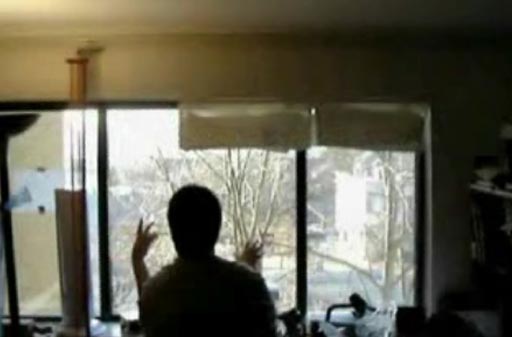
A video posted by autistic woman titled "In My Language" has sparked lively online debates on personhood, the essence of language, and the nature of her condition (some claim that someone who expresses herself so clearly can't be autistic). While these debates interest me, they weren't the questions that came to my mind on seeing the video. Instead I was fascinated by purity of experience it portrayed, a kind of purity most often seen in children, and which artists are always talking about trying to reclaim: a state of elemental awareness, an almost painful sensitivity to the world...
Last weekend 60 minutes profiled Daniel Tammet, a savant who was able to recite pi to 22,514 digits (it took him 5 hours), and was able to learn conversational Icelandic within a week. Unlike most other known savants, he can interact fairly normally with other people in everyday social situations. And unlike most other savants he can narrate his mental process. Numbers for him aren't abstract things, but objects with mental geographies, "Every number up to 10,000, I can visualize.... [each] has it's own color, has it's own shape, has it's own texture," he explained in the interview. He spoke of the beauty (and ugliness) of numbers and illustrates their forms as landscape-like paintings.
I believe savants are not much different that the woman in the first video, it's just that the focus of their intense gaze happen to to have practical application in our world—descriptions of numbers versus descriptions of water or some other more ineffable obsession. The cerebral wiring that allows this focus, limits human interaction. Daniel Tammet for all his startling abilities can't remember faces a few hours after meeting a person, instead he memorizes the number of buttons on a coat, or the count of stripes on a shirt, but even so Tammet is unusual amongst autistics. He can have human relationships. Most severely autistic people have trouble relating to anyone. What "In my Language" was saying, I thought, was that this was ok. The author wanted no pity. Her life is not empty, her gestures are not randomness, or madness as is often supposed by outside viewers, just the opposite, it is a life emotionally overfull- her brain is saturated with dense thought much of it beyond our comprehension.
Most anyone who has dabbled in the arts, I think, can relate to these inward impulses. We become immersed in the clarity of a particular interaction, in the love of the word, in an idea, in a particular emotion, or in a fleeting vision and the artistic instinct is to fix time telegraphing the moment so it can be remembered. We live for those moments of heady transparency when the mundane veneer of our lives is peeled back to reveal something extraordinary. But of course usually we fail even at holding on to the thing for ourselves. It is the rare individual who can marry impulse, idea, and technique to produce something that allows us to peek into that hidden world of extravagant beauty surrounding us... Despite our clumsy fumblings the important thing I think is to try. Because in trying we build bridges between the worlds and we become more adept at living in them both.
Related: Tammet on Wikipedia (contains many other links)


 TetsuomiSukeda
 Okajimax S.Hondart
 Koji Takiguchi
 Ayao Nakamura
 Sachiko Kawanabe
 Yoshihisa Kajioka
 Atsushi Saito